
Connect the factory without flattening IT and OT
Introduce controlled data exchange and time-limited engineering access while preserving the local operation of production cells.

Keep production cells autonomous
Restrict cross-zone traffic to named services
Control supplier maintenance access
How the solution connects
Independent uplinks meet a controlled network boundary. Local access is separated by purpose.
Read the connection map
- Corporate IT services → OT firewall + jump host · Primary path
- Approved remote engineer → OT firewall + jump host · Primary path
- OT firewall + jump host → Catalyst distribution · Policy boundary
- Catalyst distribution → Production cell A · Separate zone
- Catalyst distribution → Production cell B · Separate zone
- Catalyst distribution → Historian / integration zone · Separate zone
The challenge on the ground
Connecting machinery to reporting systems often creates an accidental bridge between the corporate network and equipment never designed for unrestricted access. Engineers need visibility, but a cloud outage or an office incident should not become a dependency for local machine control.
Start with the actual controller protocols and operating constraints.
Inside the design
Use managed Catalyst switching for the plant distribution layer, with dedicated access segments for each cell. Place an appropriately sized industrial firewall and an integration zone between OT and corporate services. These security appliances are project-specific additions to the hardware BOM.
Only named flows cross that boundary: for example, a historian collector may read a controller while general office clients cannot. Use RUT956 cellular access for a separately protected maintenance path, not an unfiltered back door into PLC networks.
Operating it day to day
Route supplier access through an approved jump host with individual identities, MFA and an expiry window. Log the session and remove access at the end of the work order.
Keep machine safety and real-time control local. Back up controller and switch configurations before maintenance, and agree the rollback decision with production rather than treating firmware updates as ordinary office patching.
What to test before handover
- Demonstrate that an office client cannot initiate a session into a production cell.
- Verify each historian flow against the approved protocol and destination list.
- Disable the WAN and confirm local production control remains available.
- Exercise supplier access, expiry and the maintenance rollback procedure.
Technical references
The bill of materials
One plant area with separate production cells, a corporate office network and a designated integration/engineering zone. Quantities below describe the example; your proposal confirms the final equipment and services.
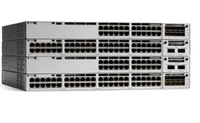
Cisco Catalyst C9300-48P-E switch
C9300-48P-EPlant distribution switching
Uplink modules and optics selected against the network design.
View product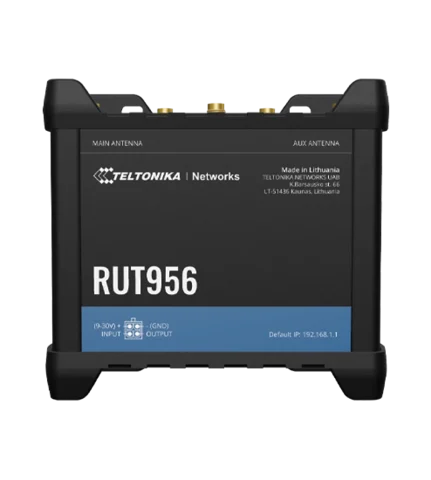
Teltonika RUT956 industrial LTE router
RUT956200000Protected cellular maintenance transport
Access must terminate at the approved firewall/jump-host boundary.
View product
APC Smart-UPS SMT1500RMI1U - 4x C13, USB, Rackmount 1U, 1500VA
SMT1500RMI1UNetwork power continuity
Validate runtime and equipment load for this 230 V model.
View productComplete the installation
The equipment above is one part of the project. Include these items in the final scope.
- Industrial firewalls and jump host
- Cell switches, optics and fibre
- Identity, logging and backup services
- Rack, grounding and environmental provisions
Questions before you specify
Are VLANs enough to protect production?
They separate broadcast domains. The design also needs enforced routing/firewall policy, controlled administration and a documented set of permitted flows.
Can a supplier connect directly over cellular?
The cellular transport should lead to the controlled maintenance boundary. Direct unrestricted access to controllers defeats the segmentation design.
Let’s design it for your site.
Send us the details below. We can turn the reference architecture into a scoped design, equipment schedule and quotation.
Start your projectBring these to the first conversation
- 01Cell and controller inventory
- 02Protocol and traffic-flow matrix
- 03Downtime windows and rollback owner
- 04Supplier access and logging requirements