
An edge rack you can operate and recover
Plan rack space, access switching and local recovery access together, so a small edge installation remains serviceable when normal management is unavailable.

Keep management access distinct
Document power and physical fit
Recover locally when remote access fails
How the solution connects
Independent uplinks meet a controlled network boundary. Local access is separated by purpose.
Read the connection map
- Production uplink → Network boundary · Primary path
- Protected management route → Network boundary · Primary path
- Network boundary → Catalyst access switching · Policy boundary
- Catalyst access switching → Compute + storage · Separate zone
- Catalyst access switching → Management interfaces · Separate zone
- Catalyst access switching → Local KVM console · Separate zone
The challenge on the ground
An edge rack often starts as a server and grows into a critical site service. Problems appear when rails do not fit, airflow is blocked by cabling or remote administration depends on the very server being repaired.
A useful design covers the physical and recovery paths as carefully as the production uplink.
Inside the design
Use Catalyst C9300 switching for the agreed access role and select uplink modules and optics against the actual traffic profile. Place server management interfaces on a restricted management network. Provide a local Digitus KVM console for compatible server interfaces.
The console is not assumed to include IP KVM; a separate device and protected route are needed for out-of-band remote access. Select rack depth, load rating and rail compatibility from the final server schedule.
Operating it day to day
Maintain a rack elevation with cable paths, power feeds and reserved space. Calculate normal and startup load, then select PDUs and UPS capacity.
Dual server power supplies only provide independent resilience if the power feeds are genuinely independent. Keep recovery credentials and a local service procedure available to authorised staff during an identity or WAN outage.
What to test before handover
- Confirm chassis, rail, console and cable-clearance dimensions before shipment.
- Test each power feed independently under the agreed operating load.
- Use the KVM to reach a server while normal remote management is unavailable.
- Verify production hosts cannot administer the management network.
Technical references
The bill of materials
One edge rack with existing compute and storage; this is an access and serviceability design, not a data-centre fabric specification. Quantities below describe the example; your proposal confirms the final equipment and services.
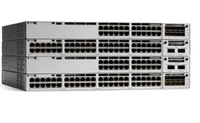
Cisco Catalyst C9300-48P-E switch
C9300-48P-EAccess-layer switching
Not specified as a high-speed storage fabric.
View product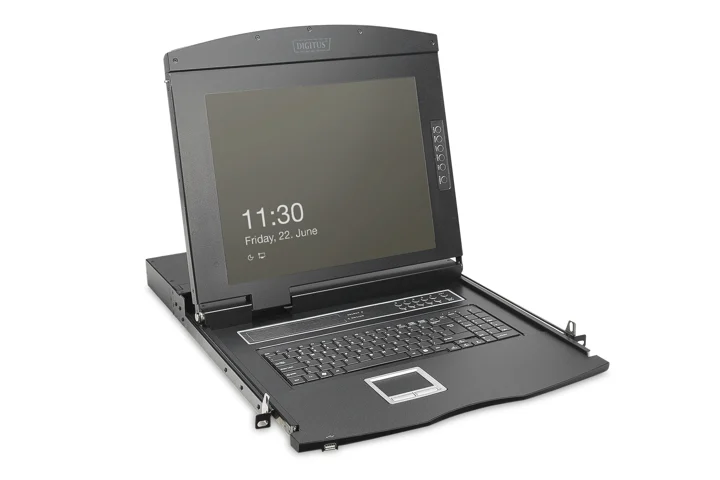
Digitus 19-inch KVM console · German layout
DS-72221-5GELocal service console
German keyboard variant shown; select the required layout and compatible adapters.
View productComplete the installation
The equipment above is one part of the project. Include these items in the final scope.
- Rack and server-specific rails
- PDUs, UPS and electrical feeds
- Uplink modules, optics and cables
- Protected out-of-band gateway and IP KVM if required
Questions before you specify
Is this a complete redundant data-centre design?
No. It is a single-rack reference for access and serviceability. Dual switching, independent power, storage fabrics and failover capacity require a separate availability design.
Let’s design it for your site.
Send us the details below. We can turn the reference architecture into a scoped design, equipment schedule and quotation.
Start your projectBring these to the first conversation
- 01Server models and rail kits
- 02Rack space and electrical feeds
- 03Traffic profile and uplink requirements
- 04Local and remote service responsibilities