Why 2.5G became the default access-layer standard
2.5 GbE (802.3bz) was specifically designed to run reliably over existing Cat5e and Cat6 cabling — the same cable that's already in most walls carrying 1 GbE today. That's the whole reason it exists: to deliver a real throughput jump without a cabling refresh. For access-layer ports feeding Wi-Fi 6E/7 APs (which can realistically deliver 2–4 Gbps to capable clients) or workstations with fast NVMe-backed network storage, 2.5G removes the 1G bottleneck at a modest cost premium.
Why 10G still matters — just not everywhere
10 GbE makes sense wherever traffic genuinely aggregates: the uplink between an access switch and the core, server NICs handling many clients' worth of traffic simultaneously, NAS/SAN storage connections, and inter-switch stacking links. Putting a 10G port at every single desk is usually wasted spend — very few individual endpoints can generate sustained 10 Gbps of traffic, and the cabling requirement (Cat6A for reliable full-distance runs) adds real cost on new builds.
The exception is specific high-throughput workstations: video editing over network storage, large dataset transfers, or any single-user workload that can genuinely saturate a multi-gig link on its own.
Cabling is the hidden cost driver
2.5 GbE's big advantage is tolerance for imperfect cabling — it was engineered to work over Cat5e and Cat6 at full 100m runs. 10 GbE (802.3an, 10GBASE-T) is far pickier: it needs Cat6A for reliable full-length runs, and Cat6 will often only sustain 10G over shorter distances (30–55m) before error rates climb. If your building has older Cat5e/Cat6 cabling throughout, jumping straight to 10G everywhere may mean a cabling refresh you didn't budget for — 2.5G avoids that problem entirely.
A practical design pattern
Most new builds in 2026 land on: 2.5 GbE (or 1G, downstream-limited by the endpoint) to individual access points and workstations, 10 GbE uplinks from each access switch to the core/aggregation switch, and 10G (or higher) directly to servers and storage. This tiers bandwidth to where it's actually consumed rather than uniformly over-provisioning every port.
Buying on FUSE
FUSE stocks 2.5G and 10G multi-gig switches from Cisco, Aruba, Ubiquiti, and MikroTik across EU warehouses in Malta, Poland, the Netherlands, and Germany.
Frequently asked questions
Do I need to rewire for 2.5 GbE?
Usually no — 2.5 GbE was designed to run reliably over existing Cat5e and Cat6 cabling at full 100m distance, which is the main reason it's become the default multi-gig access standard for refreshes and existing buildings.
Will 10 GbE work over Cat6 cabling?
It can, but only reliably over shorter distances (typically 30–55m depending on cable quality and interference). For guaranteed 10G performance at full 100m runs, Cat6A cabling is required — this is the main hidden cost of a full 10G rollout in an existing building.
Is 5 GbE worth considering instead of 2.5G or 10G?
5 GbE exists as a middle tier and is a reasonable choice for endpoints that genuinely need more than 2.5 Gbps but don't need a full 10G port — some Wi-Fi 7 APs and high-end workstations fall into this category. It's less universally supported across switch product lines than 2.5G or 10G, so check availability before designing around it.
Do I need 10G at every access switch uplink?
For any switch aggregating traffic from more than a handful of 1G/2.5G ports, yes — a 1G uplink quickly becomes the bottleneck once you have even 4–5 active 2.5G ports downstream. 10G uplinks from access to core is now the standard baseline design.
Does higher multi-gig speed mean higher power consumption?
Yes — 10GBASE-T ports draw meaningfully more power per port than 2.5G or 1G, which matters in dense switch deployments and can affect total switch power budget and cooling requirements, particularly alongside high PoE+ loads on the same switch.
Where can I buy multi-gig switches in the EU?
FUSE stocks 2.5G and 10G multi-gig switches from Cisco, Aruba, Ubiquiti, and MikroTik across EU warehouses in Malta, Poland, the Netherlands, and Germany, with trade pricing for resellers and integrators.
Buy network switches equipment on FUSE
Multi-warehouse EU stock from Malta, Poland, Netherlands, and Germany — with EU-resident technical support and trade pricing for resellers, integrators, and MSPs.
Shop the category
Live pricing and stock for the hardware compared above.
Buy the hardware in this article
Live FUSE pricing and stock for the hardware compared above.
 Cisco
CiscoCisco Catalyst C9300-48P-E network switch Managed L2/L3 Gigabit Ethernet (10/100/1000) Power over Ethernet (PoE) Grey
C9300-48P-E€7,875.07 TP-Link
TP-Link JetStream 24-Port 2.5GBASE-T and 4-Port 10GE SFP+ L2+ Managed Switch with 16-Port PoE+ & 8-Port PoE++
1722129€1,291.35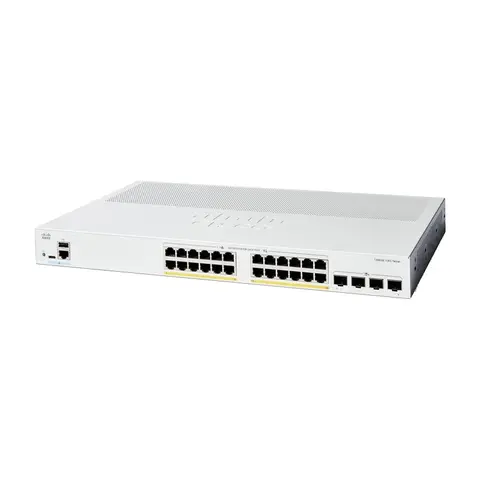 Cisco
CiscoCisco Catalyst C1300X-24P-4X network switch Managed L3 10G Ethernet (100/1000/10000) Power over Ethernet (PoE) Grey
C1300X-24P-4X€1,605.14 Cisco
CiscoCisco Catalyst 1300-16FP-2G Managed Switch, 16 Port GE, Full PoE, 2x1GE SFP, Limited Lifetime Protection (C1300-16FP-2G)
C1300-16FP-2G€920.79 Grandstream Networks
Grandstream Networks GWN7813P network switch Managed L3 Gigabit Ethernet (10/100/1000) Power over Ethernet (PoE) Grey
GWN7813P€407.89 TP-Link
TP-Link 16-Port 10/100Mbps + 2-Port Gigabit Unmanaged PoE Switch
TL-SL1218MP€196.04